





Skip to content
Free guides and 18 planning tools for every stage of your weddingExplore the tools
THE WEDDINGBLUEPRINT
Ebook shop

Wedding budget guide: A budget that tells you the truth.

What weddings really cost, how to split a total into categories, who traditionally pays for what, and where money quietly disappears.

A wedding budget is not a number you pick and hope for. It is a set of priorities with prices attached. The couples who stay on budget decide early what matters most, keep a buffer, and compare quotes on the same basis — including the taxes, fees and gratuities that rarely appear in the headline price.

Before the wedding · 03 5 in-depth articles 3 free tools 6 answered questions
A couple working through bills and a budget with a calculator
Photo · Mikhail Nilov / Pexels

What does the average wedding cost?

About $34,000 for US weddings in 2025, according to The Knot’s 2026 Real Weddings Study of 10,474 couples — about $292 per guest. Averages are a reference, not a target.

What is usually the biggest expense?

The venue and catering. The Knot reports an average reception venue spend of $12,900, and catering around $80 per person.

How much buffer should we keep?

Keep 5–10% unallocated. It covers overtime, service charges, extra guests and the small purchases that add up in the final month.

Who pays for the wedding now?

Most couples pay for at least part of it themselves, often with family contributions. Clarify amounts and expectations before you count on them.

What weddings actually cost

The Knot’s 2026 Real Weddings Study surveyed couples married in 2025. Use these as a reference point for your own quotes, not a checklist of things you must buy.

CategoryAverage spend (US, 2025 weddings)
Reception venue$12,900
Cateringabout $80 per person
Photographer$3,000
Florist$2,800
Alcohol$2,800
Videographer$2,300
Wedding dress$2,100
Event rentals$2,000
Lighting & décor$1,900
DJ (reception)$1,800
Cake$540
Officiant$260

Source: The Knot 2026 Real Weddings Study, as reported by The Knot and AOL. Prices vary widely by region: Zola’s cost index found a 150-guest wedding in San Francisco costs about twice as much as the same wedding in Milwaukee.

Split your total into categories

A percentage split turns “we have $25,000” into something you can shop with. A common starting point:

CategoryShare of budget
Venue, food & drink45–50%
Photography & video10–12%
Attire & beauty8–10%
Flowers & décor8–10%
Music & entertainment5–8%
Stationery, favors, cake & extras5–7%
Buffer5–10%

The budget planner does this for any total, lets you move sliders to match your priorities, and shows where you sit against the national averages.

Where money quietly disappears

Our guide to hidden wedding costs goes through each one with the questions to ask.

Who traditionally pays for what

Tradition said the bride’s family paid for most of the wedding and the groom’s family paid for the rehearsal dinner, officiant and honeymoon. Very few families follow that script now. Zola’s 2026 research found 88% of couples contributing financially and 71% receiving some help from family. What matters is clarity: how much, when, and whether the money comes with expectations (guest list seats, say in the venue). Read who pays for what.

Saving money without it feeling cheap

The biggest lever is guest count, then day of the week, then season. After that: a venue that includes tables, chairs and linens; fewer, fuller floral pieces; a cake-cutting cake plus sheet cake; digital save-the-dates; and choosing where you won’t compromise. See ways to save that guests won’t notice.

Paying for it without debt

  1. Know your real total from savings, monthly saving until the date and confirmed contributions.
  2. Open a separate wedding account so every payment comes from one place.
  3. Map the payment schedule: deposits early, installments in the middle, final balances in the last weeks.
  4. Match payments to savings, so no balance lands before the money exists.
  5. Keep the buffer untouched until the final month.

If a card helps with protection or points, pay it off in full each month. Zola’s 2026 report found many couples postponing other goals to pay for their wedding; a budget you can pay in cash protects the life you’re planning after it.
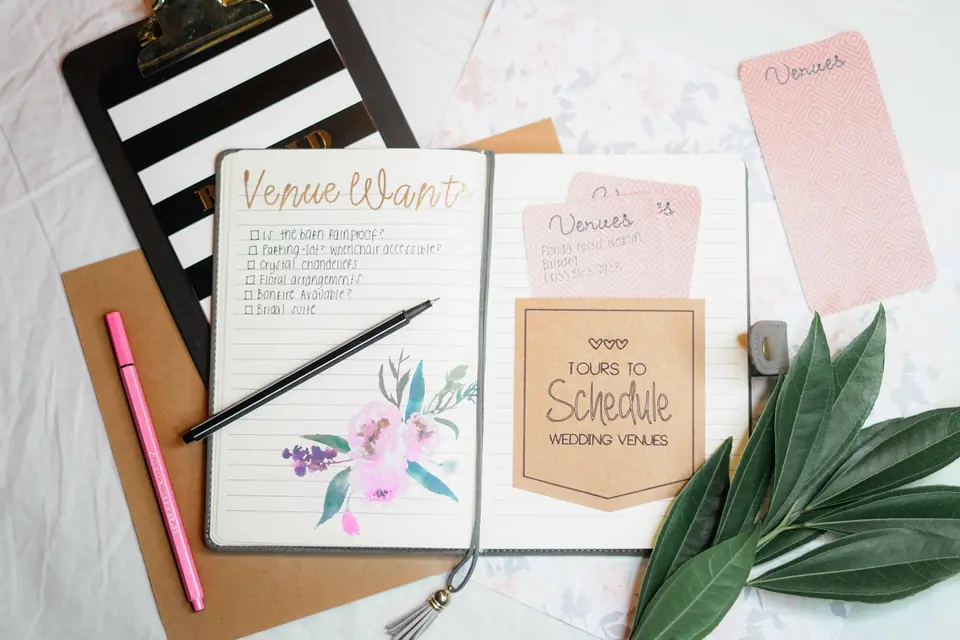

A pastel planning notebook with venue notes, a pen and stationery
Photo · Natasha Fernandez / Pexels
A young couple on a sofa looking at a phone together
Photo · Vitaly Gariev / Unsplash
An open notebook with a pen, rings and white flowers on a marble table
Photo · Ylanite Koppens / Pexels

Questions about budget & who pays

Asked and answered.

More in our full questions and answers.

How much should a wedding cost?

Whatever you can pay without going into debt you’d regret. The US average was about $34,000 for 2025 weddings (The Knot), but many beautiful weddings cost a fraction of that. Start from your savings and monthly capacity, not the average.

How much does a wedding cost per guest?

The Knot’s 2026 study puts the average at about $292 per guest across all costs. Catering alone averaged about $80 per person before drinks, service and tax.

How much of the budget should go to the venue?

Venue plus food and drink usually takes 45–50% of the total. If your venue includes catering, rentals and staffing, that share can be higher and still good value.

Who pays for the bridesmaid dresses?

Traditionally each bridesmaid pays for her own outfit. If you choose something expensive or specific, consider covering part of it, or let people choose their own dress in a color.

Should we go into debt for our wedding?

Only you can decide, but many couples who do regret it. Zola’s 2026 research found 52% of couples postponing other goals, like saving or buying a home, because of wedding costs.

Should we take out a loan to pay for our wedding?

It’s usually wiser to scale the wedding to what you can pay from savings and confirmed contributions. Debt can delay goals like a home or starting a family.

The planning letter

One calm, useful email at a time.

A short note for your planning season: one idea worth knowing, one tool to try, and a reminder of what matters this month. No spam, ever.

Occasional emails, easy unsubscribe. Privacy policy.

We use analytics cookies to understand how visitors use our site. Functional cookies (session and page variant) are always set. See our Privacy Policy.